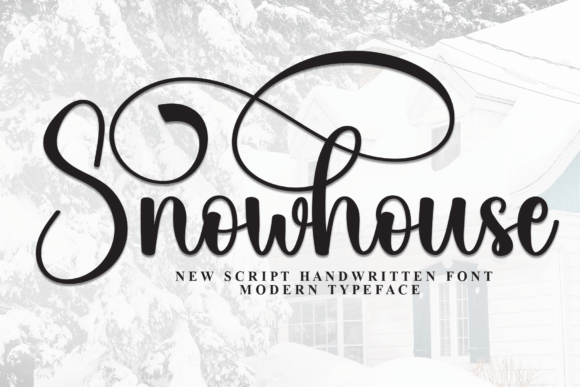
Bringing Warmth to Your Designs with Snowhouse
When you look at a typeface like Snowhouse, you aren't just seeing letters; you are seeing a mood. In a digital landscape often dominated by rigid sans serif fonts and cold, geometric shapes, finding a handwritten font that strikes the perfect balance between casual charm and professional polish can be a game-changer. Snowhouse manages to capture that elusive "personal touch" without sacrificing legibility. It features flowing, graceful curves that mimic the natural rhythm of a hand-lettering artist, making it a standout choice for anyone looking to inject a bit of humanity into their visual assets.
The visual personality of this typeface is defined by its delicate strokes and elegant slant. It doesn't look messy or overly "scrawled," which is a common pitfall with many script fonts. Instead, Snowhouse feels intentional. The letterforms connect in a way that feels organic, creating a sense of movement that guides the eye across the page. For designers, this means you get the aesthetic of custom calligraphy with the consistency and reliability of a digital font. It is a premium font choice that speaks to quality, offering a warmth that resonates with audiences looking for authenticity.
Strategic Applications: Where Snowhouse Shines
Understanding where to deploy a creative font like Snowhouse is just as important as selecting it. Because it is a display font with distinct character, it works best in scenarios where personality takes precedence over dense information. It is not the typeface you want for a 500-word legal disclaimer, but it is exactly what you need to make a headline pop or a logo feel inviting.
Branding and Logo Design
For entrepreneurs and small business owners, your brand identity is your handshake. Snowhouse is an exceptional choice for industries that rely on trust and personal connection. Think of a boutique bakery, a high-end wedding planner, a lifestyle coach, or a handmade jewelry shop. In logo design, this font acts as the visual voice of the brand. Its elegance suggests care and attention to detail. However, when using it for logos, ensure the letter spacing is adjusted correctly. Script fonts often benefit from slightly tighter tracking to ensure the letters feel connected as a single unit rather than floating apart.
Editorial and Packaging Design
In the realm of editorial design and packaging design, typography is used to create hierarchy. Snowhouse excels as a secondary font or for pull quotes. Imagine a magazine layout with a bold sans serif headline and a sub-headline in Snowhouse; the contrast creates immediate visual interest. On packaging, particularly for products like artisanal foods, cosmetics, or stationery, this typeface adds a layer of sophistication. It suggests that the product inside is crafted with care. It transforms a simple label into a story, helping the product stand out on crowded shelves.
Digital Presence and Social Media
The utility of Snowhouse extends heavily into web design and social media graphics. On a website, it is best used for hero text or section headers rather than body copy. It draws the visitor in immediately. For content creators and bloggers, this font is a powerful tool for Instagram posts, Pinterest pins, and YouTube thumbnails. It mimics the handwritten notes that perform so well on social platforms because they feel native to the medium. When you use Snowhouse for a "quote of the day" graphic or a sale announcement, you break the monotony of standard text, increasing the likelihood of engagement.
Mastering Typography: Pairing and Readability
The true mark of a professional designer is not just picking a beautiful font, but knowing how to pair it. Snowhouse is a distinct handwritten font, meaning it has a strong personality. To maintain visual hierarchy and readability, it requires a grounding partner.
The safest and most effective strategy is to pair this script font with a clean, neutral sans serif font or a classic serif font. For example, using Snowhouse for headers and a geometric sans serif like Montserrat or a humanist sans serif like Open Sans for body text creates a perfect balance. The sans serif provides the necessary legibility for smaller screens and longer paragraphs, while Snowhouse provides the flair. Avoid pairing it with other decorative or overly stylized fonts, as this will result in visual chaos. You want contrast, not competition.
Readability considerations are paramount. Because Snowhouse features cursive connections and flowing lines, it should be set at a larger size. It is not designed for fine print. When applying it to web design, ensure there is sufficient line height (leading) so the ascenders and descenders of the letters don't clash with the lines above and below. Color contrast also matters; dark text on a light background (or vice versa) is essential to ensure those delicate strokes don't get lost.
Practical Guidance for Implementation
If you are ready to integrate Snowhouse into your design assets, there are a few practical steps to ensure you get the most out of it. First, review the included styles and character map. High-quality premium fonts often include alternate characters, ligatures, and swashes. These variations allow you to customize the look of specific letters, preventing repetitive shapes and adding a truly hand-crafted feel to your logos or invitations.
Next, consider the licensing. If you are a freelancer or a business owner, ensure you are acquiring a commercial font license that covers your specific usage. Most font foundries offer different tiers for desktop use (print), web use (fonts hosted on your server), and app embedding. Adhering to these licensing terms is a hallmark of a professional creative industry participant and protects you legally.
Finally, always test your typography in context. Don't just look at the letters on a blank white artboard. Mock it up on a business card, a mobile screen, or a product label. See how Snowhouse interacts with your photography and color palette. Does it look too crowded? Does it stand out enough? By moving beyond theory and testing the font in real-world environments, you ensure that your final design is not only beautiful but functional and effective for your audience.