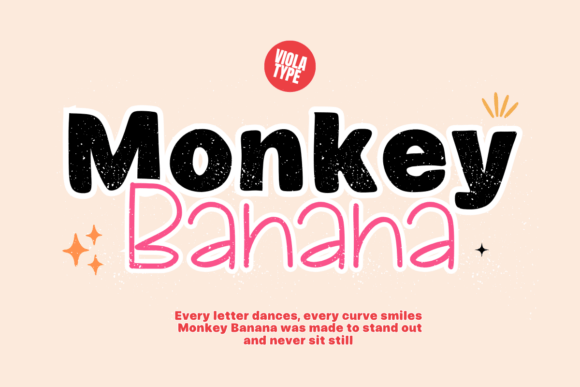
Monkey Banana: A Playful Font Duo for Cheerful Designs
Every designer knows the feeling. You’re staring at a brief for a children’s party invitation, a new café menu, or a social media graphic for a local yoga studio. The project calls for something friendly, approachable, and full of character. It needs to feel handmade but not messy, bold but not aggressive. Scrolling through your library of serif fonts and sans serif fonts leaves you cold. What you need is a typeface with a genuine smile built into its curves. This is exactly the space where the Monkey Banana font duo lives.
At its core, Monkey Banana is a premium font package that solves a common pairing problem. It combines two distinct but complementary styles. The first is a light, flowing script font that mimics the natural rhythm of handwritten font styles. It has a casual, organic quality—perfect for subtitles, accents, or personal messages. The second is a chunky, confident display font with rounded edges and a bold stance. It commands attention without feeling heavy. Together, they create a visual conversation: one voice is soft and personal, the other is loud and joyful. This isn’t just about picking two random typefaces; it’s about having a pre-tested, cohesive system for creating visual hierarchy instantly.
Visual Personality: Where Quirky Meets Professional
The strength of Monkey Banana lies in its personality. It avoids the trap of looking childish or unprofessional. Instead, it walks a fine line. The bold display component has a slightly retro, cartoonish charm reminiscent of vintage packaging or classic animated title cards. The letterforms are generous, with ample counter-spacing that ensures the readability remains high even at smaller sizes. This makes it a surprisingly versatile creative font for web design headers or app interfaces where you need to inject warmth without sacrificing clarity.
The script element is where the handwritten font influence shines. It’s loose and free-flowing, but carefully crafted to avoid the awkward joins or illegible loops that plague many script typefaces. When you use the bold style for a main headline like "Summer Sale" and the script underneath for "Up to 50% Off," you’re not just organizing information—you’re telling a story. You’re building brand perception that feels approachable and human. This is critical for entrepreneurs and small business owners who want their brand identity to feel like a conversation rather than a corporate broadcast.
Real-World Applications and Project Fit
So, where does this font duo actually work? Its applications are broad, but it excels in projects where friendliness is a key selling point. Think about packaging design for artisanal goods—honey jars, organic snacks, or boutique candles. The bold "Monkey Banana" style can anchor the brand name on the front of the box, while the script can describe the flavor or ingredients on the side. This creates a cohesive look that stands out on a shelf crowded with sterile, minimalist typography.
For editorial design, particularly in magazines or blogs targeting lifestyle, parenting, or food, this typeface offers a refreshing break from standard corporate fonts. Use it for pull quotes or section headers to break up long blocks of text. It draws the reader’s eye and signals that the content is meant to be enjoyed, not just consumed. Social media graphics are another natural habitat. In the fast-scrolling world of Instagram or Pinterest, a bold, cheerful header created with a display font like this stops the thumb. It’s ideal for announcements, sale graphics, or motivational quotes.
Strategic Font Pairing and Hierarchy
While Monkey Banana works beautifully as a standalone system, knowing how to pair it with other design assets expands its utility. Because the duo is so expressive, it usually benefits from being paired with a neutral, geometric sans serif font for body copy. Imagine a website landing page. You might use the bold "Monkey Banana" style for the main H1 headline to grab attention. Below that, the script style could serve as a sub-header to add a personal touch. For the actual paragraph text describing your product or service, switch to a clean, simple sans-serif. This combination maintains the playful energy of the brand while ensuring the longer text is easy to scan and read on screens.
When evaluating fit for your specific project, consider the tone. If you are designing a logo design for a pediatric dentist or a toy store, the font is a natural fit. Its rounded shapes feel safe and friendly. However, if you are working on a corporate law firm’s annual report, it’s obviously the wrong tool. The key to using creative fonts effectively is matching the font’s voice to the brand’s voice. Monkey Banana speaks the language of fun, creativity, and approachability.
Practical Considerations for Designers and Creators
Before integrating any new premium font into your workflow, a practical review is necessary. First, check the character set. A high-quality font duo should include alternates, ligatures, and multilingual support. These features allow you to customize the look of the text so it doesn’t appear repetitive. For example, if you are using the script style for a word like "connect," having alternate versions of the double 'c' or the 'e' can make the typography look more authentic and less digital.
Licensing is another critical factor, especially for commercial use. Most commercial fonts require specific licenses for different applications—one for desktop use (creating logos or print materials), one for web use (embedding in a site’s CSS), and sometimes one for app usage. Always verify that the license covers your intended use, whether you are a freelance designer creating assets for a client or a business owner using the font on your own merchandise. This protects you legally and ensures you are respecting the work of the type designers.
Finally, test the font in context. Don’t just look at the specimen sheet provided by the foundry. Download the files, install them, and type out your actual content. See how the letters connect in the script style with your specific words. Check the spacing (kerning) of the display font in your headlines. A font pairing that looks great in a preview might need slight tracking adjustments in your specific layout. By taking the time to test and tweak, you ensure that the Monkey Banana font duo brings that intended joy and personality to your final design, whether it’s a book cover, a t-shirt graphic, or a website header.